Sabiha Gökçen Airport: Difference between revisions
No edit summary |
No edit summary |
||
| (One intermediate revision by one other user not shown) | |||
| Line 166: | Line 166: | ||
==== South Config ==== | ==== South Config ==== | ||
<gallery widths="350" heights="250"> | |||
File:DRAMO 1U, VUTZO 1H, ETAMP 1H STARs of LTFJ.png|DRAMO 1U, VUTZO 1H, ETAMP 1H STARs of LTFJ | |||
File:GINLI 1H, IBODU 1H, DRAMO 1H STARs of LTFJ.png|GINLI 1H, IBODU 1H, DRAMO 1H STARs of LTFJ | |||
File:NAMAN 1H, TOKER 1H STARs of LTFJ.png|NAMAN 1H, TOKER 1H STARs of LTFJ | |||
</gallery> | |||
== Local Traffic Regulations == | == Local Traffic Regulations == | ||
Latest revision as of 19:46, 30 September 2026

Sabiha Gökçen Airport (IATA:SAW, ICAO: LTFJ) is one of the busiest airports in Türkiye and is located on the eastern side of Istanbul. With 48.4 million passengers in 2025, it was the second-busiest airport in Türkiye and ranked 9th among European airports by passenger traffic.
The airport currently operates with two runways. The second runway, measuring 3,540 metres in length, was officially opened on 25 December 2023. Its introduction significantly increased the airport's air traffic capacity and also enabled wide-body aircraft operations.
Sabiha Gökçen serves as a major hub for Pegasus Airlines and is an important base for a number of airlines operating domestic and international services. The airport continues to experience significant growth, with passenger traffic increasing by 16.7% in 2025 compared with the previous year.
Payware
You can find the table which includes all the payware sceneries for Sabiha Gökçen Airport.
| Simulator | Developer | Publisher | Links |
|---|---|---|---|
| FSX/P3D | SceneryTR | SimMarket | Simmarket |
| Microsoft Flight Simulator 2020 | SceneryTR | SimMarket | Simmarket |
| Microsoft Flight Simulator 2024 | SceneryTR | SimMarket | Simmarket |
| Microsoft Flight Simulator 2020 | MXI Design | SimMarket | Simmarket |
| Microsoft Flight Simulator 2024 | MXI Design | SimMarket | Simmarket |
| X-Plane 12 | Geobuilds | Geobuilds | XPlane.org |
Freeware
There are also freeware options available for Sabiha Gökçen Airport. However there is significant difference in quality.
| Simulator | Developer | Publisher | Links |
|---|---|---|---|
| FSX/P3D | Murat Koncavar | Sanal Pilot | Sanal Pilot |
| Microsoft Flight Simulator 2004 | Murat Koncavar | Sanal Pilot | Sanal Pilot |
| X-Plane 11/12 | Argaeus | Threshold Forum | Threshold |
Preferential Runway System (PRS)
The term “Preferential RWY System (PRS)” shall be used to indicate the runway that, at a particular time, is considered by the ATC unit to be the most suitable for use by the aircraft expected to land at or take-off from the aerodrome, by taking into consideration aircraft performance, surface wind speed and its components. PRS Operations contribute to the optimum use of airspace and aerodrome capacity.
Preferential RWYs for Sabiha Gökçen Airport (LTFJ) follow the LTFM runway configuration, provided that the tailwind component does not exceed 10 KT.
| RWYCC (Runway Condition Code) | Tail Wind Component (max) |
|---|---|
| RWYCC 6/6/6
(dry, maximum braking) |
10 KT (included) |
| When RWYCC is reported at least 5 for any each runway third
(worse than dry, low braking |
5 KT (included) |
- In the PRS operations, the above wind criteria depending on the runway surface condition shall be applied.
- During the PRS operations, ATC unit takes into account the ground wind, traffic situation, local meteorological conditions, environmental restrictions, technical infrastructure, noise abatement, etc.
- PRS operations will not be available under the following circumstances:
- The instrument approach/departure procedures available for the preferred RWY(s) are not convenient for landing and/ or take-off operations under the existing meteorological conditions
- When the preferred RWY(s) are dry (RWYCC[1] 6/6/6), the tail wind component is greater than 10 Kt,
- When RWYCC is reported at least 5 for any each the preferred RWY(s) third, the tail wind component is greater than 5 Kt,
- When RWYCC is reported at least 5 for any each the preferred RWY(s) third, there is a NOTAM/equivalent information (which may be included in the RCR) stating that the runway is slippery,ATIS announcement when PRS Operations are in progress shall be; “Preferential Runway Operations are in Progress”.
- RWYCC is reported 4 or less any each the preferred RWY(s) third,
- Meteorological conditions such as heavy rainfall, thunderstorm or wind-shear has been reported on the approach or climb path of the preferred RWY(s),
- Low visibility operations are in progress.
- ATIS announcement when PRS Operations are in progress shall be; “Preferential Runway Operations are in Progress”.
- Pilots unable to comply with PRS Operations shall notify the relevant ATC unit at the time of requesting start-up clearance, at the first contact or 20 minutes in advance of the ETA (which is earlier).

Arrival Procedures
Introduction
Sabiha Gökçen Airport is located within Yesilkoy TMA (Terminal Manoeuvring Area). Yesilkoy TMA covers Istanbul Airport (LTFM), Sabiha Gökçen Airport (LTFJ), Ataturk Airport (LTBA), Samandira Airbase (LTBX), Corlu Ataturk Airport (LTBU), Hezarfen Municipal Airport (LTBW), Cengiz Topel Airport (LTBQ), Bursa Yunuseli Airport (LTBE) and Bursa Yenisehir Airport (LTBQ).
Sabiha Gökçen Airpor utilizes RNAV in all of its procedures. In addition, P-RNAV (Precision-Area Navigation, RNP1) capability is required. If unable, pilots must inform the controller so that aircraft can be given radar vectors to final. Arrival into Sabiha Gökçen Airport might seem complicated to some pilots however it is actually very simple. STARs utilize PMS (Point Merge System) for efficient airspace control, separation, and to control traffic flow within Yesilkoy TMA. All STARs utilize idle descent philosophy until PMS entry. These point merge systems act as an arc of a circle and ease air traffic control.
Important things to keep in mind:
- Vacating aircraft has priority at the intersection of the parallel taxiway. Which means, if you are vacating a RWY using rapid exit, the traffic on D should stop for you.
- After the runway is vacated, do not report vacated to TWR* and DO NOT STOP on rapid-exit taxiways.
*unless LVP is in progress. Check next section for more details.
Low Visibility Procedure
- When LVP are in progress, every traffic must report "Vacated" to the TWR, as verbal confirmation from the traffic is mandatory and for the TWR to know the runway is available for the next traffic.
- Traffics shall report lift-off information when airborne if requested by ATC. Then connect immediately to approach
STARs
The STARs at Sabiha Gökçen Airport are designed to be ambiguous between the active runways. For instance, if northern config is active, IBODU 2G STAR will end at OBIXI waypoint, and OBIXI is IAF (Initial Approach Fix) for all approach procedures for both RWY 06L and 06R, which is where the transition starts. You might hear the phraseology:
via OBIXI transition, cleared ILS-Z approach 06R06R
This means, whether you land at 06L or 06R (when north config is active), you still use the same STAR procedure for all runways. You can find the STAR designator table on the next page.
| Active Runway Configuration | ||||||
|---|---|---|---|---|---|---|
North Configuration (RWY 06L/R) uses the following STAR identifiers.
*Alternative: Only used/issued by ATC. | ||||||
South Configuration (RWY 24L/R) uses the following STAR identifiers.
*Alternative: Only used/issued by ATC. |
As Sabiha Gökçen Airport utilizes multiple configurations depending on traffic, weather, congestion, NOTAMs etc. You might be cleared to a different STAR compared to another traffic that is flying exactly the same route as you. Default designators for northern config (RWY 06L/R) is 1G and default designator for southern configuration (RWY 24L/R) is 1H. The procedures and STARs for Sabiha Gökçen Airport were built to utilize Yesilkoy TMA most efficiently with the Istanbul Airport (LTFM) STARs.
North Config
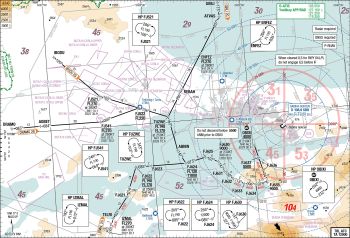
IBODU 1G, GINLI 1G, DRAMO 1G, VUTZO 1G STARs of LTFJ
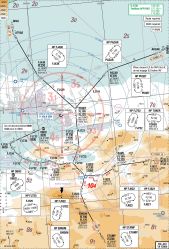
GINLI 1T, NAMAN 1G, TOKER 1G, ETAMP 1G STARs of LTFJ


South Config
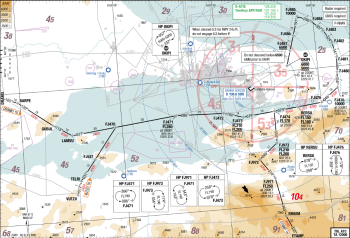
DRAMO 1U, VUTZO 1H, ETAMP 1H STARs of LTFJ
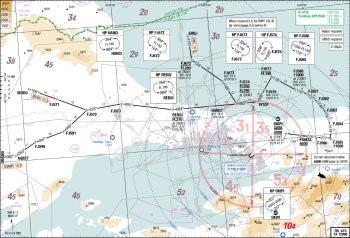
GINLI 1H, IBODU 1H, DRAMO 1H STARs of LTFJ
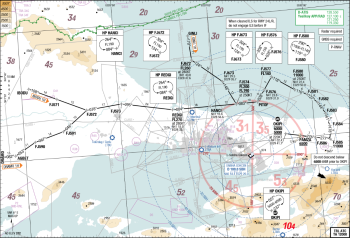
NAMAN 1H, TOKER 1H STARs of LTFJ


Local Traffic Regulations
Procedures For Departing and Landing Aircraft
- Pilots of departing aircraft are reminded to contact ATC for ATC clearance 10 minutes before start-up.
- The start-up according to EOBT is under pilot’s responsibility.
- The departure radar sector frequency will not be given by tower unless it is different than given by ATIS or clearance delivery,
- Push back shall not be requested unless full ready. When cleared by ATC, traffic should start to push back within 60 seconds.
- Runway vacating should not be reported to Tower frequency unless instructed by Tower. Pilots shall contact to ground frequency 121.750 MHZ (if online) after vacating runway.
- All aircraft vacating a RWY via Rapid Exit Taxiway has the priority at the intersection of the taxiways, over the aircraft taxiing on other taxiways. All pilots shall be cautious about this priority and unless otherwise instructed not to do so, give way to the aircraft vacating a RWY via one of the Rapid Exit Taxiways.
QNH & Transition Level
During the approach phase of arriving aircraft, LTBA QNH and TL values given by YESLIKOY APP shall be used. LTFJ QNH value will be given on first contact to Gökçen Tower.
Pilot Reaction and Runway Occupation Time
- Pilot’s reaction time shall not be exceed 10 seconds for departure clearance and 60 seconds for push-back clearance.
- If pilots are unable to comply these rules they should inform tower as soon as possible.
- Landing aircraft shall vacate runway via the most appropriate taxiway whose distances are indicated in the following table to reduce runway occupation time. The given distances in the table are not Declared Distances“but only for guidance.
| Landing Runway | A7 | A8 | A9 | A6 | A5 | A4 |
| 06R | 1930m | 2330m | 2730m | - | - | - |
| 24L | - | - | - | 1950m | 2350m | 2750m |
- After landing, flight crew are invited to vacate the RWY as fast and safely as possible, by using distances which is given above of rapid exit TWYs A7 or A8 for the RWY 06R and TWYs A6 or A5 for the RWY 24L. If unable, inform Gökçen TWR as soon as possible.
Standard Push-back Procedures
- Standard push-back procedures are mandatory for all parking positions except parking positions 14A, 15A, 51, 52, 53 and 54. Power back is forbidden by using reverse thrust. Unless otherwise notified by ground control, push-back shall be done to the direction of the runway in use with the exceptions below. For stand numbers 112 and 113 pushback shall always be done towards east. (nose of ACFT towards RWY 24R). For Apron 6, Apron 7 and Apron 8 pushback shall always be done nose of ACFT towards north.
- For stand numbers 1 and 2 push-back shall be done to the west (nose of aircraft will be face to the RWY 06L)
- For stand numbers 301 and 308, push back shall be done to Apron exit.
- For stand numbers 402, 402A, 402B, 403, 403A, 403B, 404, 405, 406 and 407 push-back shall be done to the west (nose of aircraft will be faced to the RWY 06L).
- Aircraft standing at 404 and 405 parking positions, should not start the engine during push-back, engine start will be done after the aircraft get on the apron centreline.
Advanced Surface Movement Guidance and Control System
Sabiha Gökçen Airport is equipped with mode-S capable advanced surface movement guidance and control system (A-SMGCS). Pilots, must ensure that, aircraft transponder is set to transmit mode-S signals and associated mode-A code, from the request for push-back or taxi, whichever is earlier and after landing, continuously until aircraft is fully parked on stand.
- ↑ Runway Condition Code